LinkedIn sales headline examples: 32 honest formulas (2026)
Use 32 LinkedIn sales headline examples for SDRs, AEs, founders, leaders, and RevOps. Choose honest proof with a four-level evidence ladder.
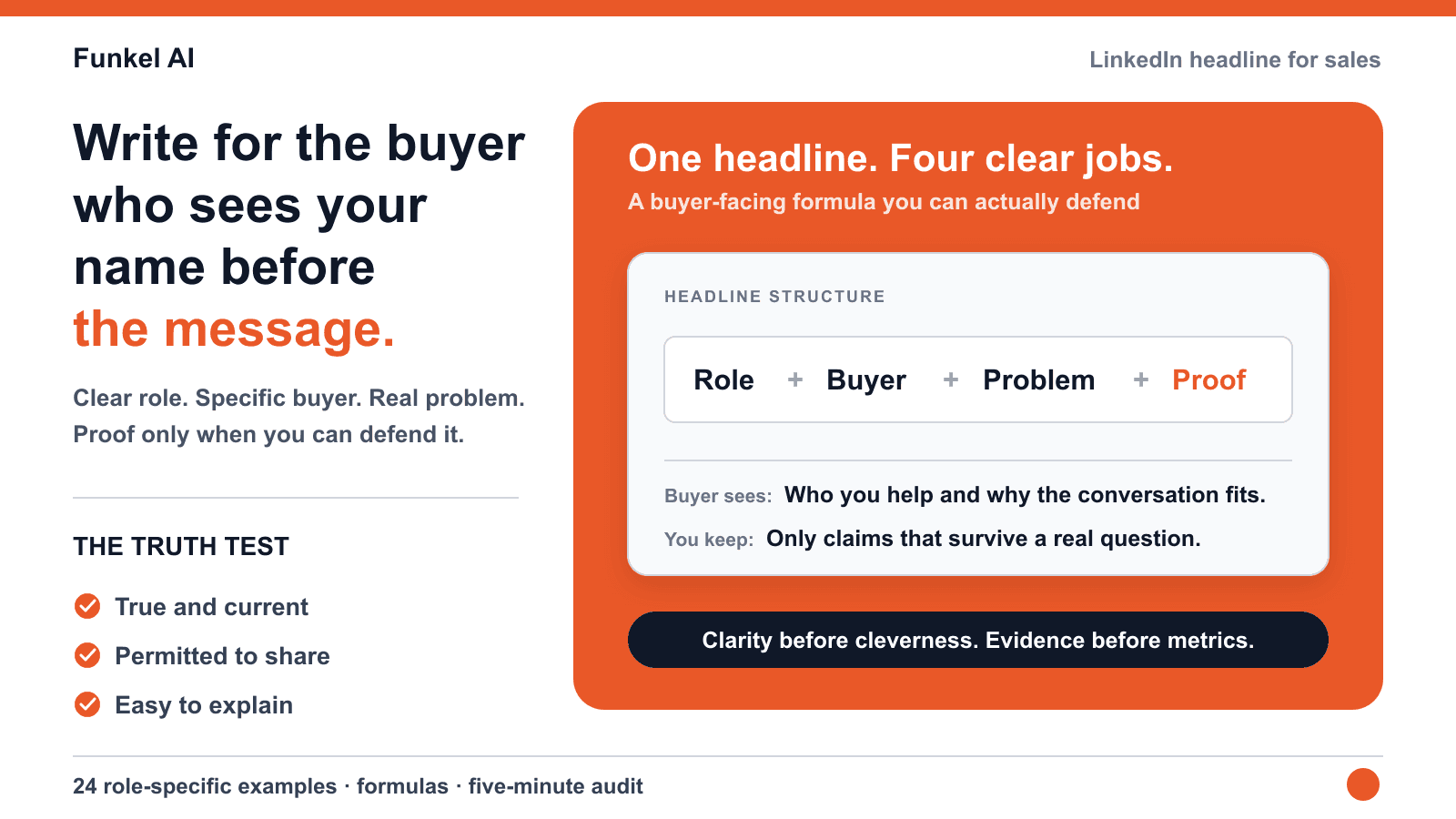
A good LinkedIn headline for sales tells a buyer what role you play, who you help, which problem or outcome you work on, and one honest reason to trust you. It should make sense in search results, connection requests, comments, and a real sales conversation without relying on vague buzzwords or results you cannot verify.
That is a different job from writing a headline for recruiters. A recruiter may search for your title, territory, and experience. A prospect is asking a quieter question: “Why is this person relevant to me?” If outbound is part of your role, write for the buyer first and keep enough role language for people to understand what you do.
What makes a good LinkedIn sales headline?
LinkedIn’s own guide to an effective sales profile treats the profile as more than a résumé. Its headline guidance asks sellers to show what they do, who they do it for, the value they offer, what differentiates them, and proof they can deliver. That is a useful checklist, but you do not need to force every element into one line.
Start with four building blocks:
| Block | Question it answers | Useful language |
|---|---|---|
| Role | What kind of conversation can you own? | SDR, account executive, founder, sales leader, RevOps |
| Buyer | Who should recognize themselves? | B2B SaaS founders, revenue leaders, security teams |
| Problem or outcome | Why should that buyer keep reading? | Fixing pipeline handoffs, evaluating intent data, reducing research work |
| Proof or differentiator | Why should they believe you? | Industry focus, operating specialty, customer-approved result |
The order can change. A familiar title may lead when recruiter discovery matters. The buyer and problem can lead when prospecting is the priority. Honest proof is optional; invented proof is not.
Choose one primary audience before you write
Most weak headlines try to speak to buyers, recruiters, peers, and potential hires at the same time. The result is a row of nouns that describes the person but gives nobody a reason to continue.
| Primary audience | Lead with | Keep secondary |
|---|---|---|
| Buyers | Buyer, problem, useful outcome | Title, employer, approved proof |
| Recruiters | Recognizable role, specialty, market | Buyer-facing value statement |
| Peers and partners | Category, point of view, operating focus | Title and company |
| Hybrid | Role plus one buyer-facing promise | Everything that needs explanation |
A public r/sales discussion about a new SDR choosing a LinkedIn headline captures the tension well: the job title is accurate, but the value statement can become vague before the rep has enough experience to prove it. The safest answer is clarity. Name the role, market, and problem without borrowing somebody else’s results.
Four LinkedIn headline formulas for sales
Use formulas as scaffolding, not copy. Replace every bracket with language you can defend.
- Role + buyer + problem:
[Role] | Helping [buyer] work through [problem] - Buyer + outcome + role:
Helping [buyer] reach [outcome] | [Role] at [company] - Category + specialty + market:
[Category] for [market] | [Specialty] | [Role] - Role + buyer + verified proof:
[Role] for [buyer] | [Result you can verify and share]
The fourth formula is not automatically stronger. A precise industry focus can be more credible than an unexplained percentage. If a customer, employer, or buyer would challenge the claim, remove it until you can show the evidence.
32 honest LinkedIn headline examples for sales
These are templates, not fictional achievements. Keep the bracketed parts until you can replace them with true details, and delete any proof block you cannot share.
LinkedIn headlines for SDRs and BDRs
- SDR | Starting useful conversations with [buyer] about [problem]
- Sales Development at [company] | [Category] for [market]
- BDR for [industry] teams | Research-first outbound | [Territory]
- Helping [buyer] evaluate [category] | SDR at [company]
New reps do not need to pretend they have a personal book of customer results. A clear role, market, and problem is enough to start. The profile can earn more proof over time.
LinkedIn headlines for account executives
- Account Executive | [Category] for [market] | Focused on [problem]
- Enterprise AE at [company] | Working with [buyer] on [initiative]
- Helping [buyer] move from [current state] to [desired state] | AE
- Account Executive | [Territory] | [Verified specialty or result]
An AE headline can reflect the deal context the buyer will recognize: market, initiative, complexity, or territory. It does not need a hard CTA. The next profile section can explain the offer in more detail.
LinkedIn headlines for sales leaders
- VP of Sales | Building [sales motion] for [market]
- Head of Sales at [company] | [Category] | [Buyer problem]
- Sales leader | Hiring, coaching, and operating [motion]
- Scaling [motion] across [market] | [Verified differentiator]
- VP of Sales | Helping [buyer] improve [workflow] with [category]
- Player-coach Head of Sales | Selling [category] while building [team]
- Fractional VP Sales | Helping [stage] founders build [sales motion]
- Revenue leader | Aligning marketing, sales, and success around [outcome]
- Sales enablement leader | Helping [team] improve [specific workflow]
- Enterprise sales leader | [Market] | [Complex buying problem]
- Regional sales director | [Region] | [Buyer] | [Category]
- Head of Sales at [company] | [Team priority] | [Buyer-facing promise]
Sales leaders often need a hybrid headline: credible to candidates and peers, but still legible to buyers. One operating focus is usually more memorable than a list of every function the leader owns.
| Next conversation | Lead with | Leave out |
|---|---|---|
| Buyer or customer | Buyer, problem, category, supportable outcome | An internal org chart or a list of management duties |
| Candidate or team | Leadership role, sales motion, market, team-building priority | Generic culture claims that the profile cannot prove |
| Peer or partner | Operating specialty, stage, market, useful point of view | Every tool, channel, and function you oversee |
| Recruiter | Recognizable title, scope, segment, region | A buyer promise that hides your actual seniority |
Choose the next conversation before choosing the wording. A VP selling into enterprise accounts needs a different first line from a player-coach hiring the first three reps, even when both people own the same broad function. Keep one secondary audience visible, not all of them.
LinkedIn headlines for founders doing sales
- Founder at [company] | We help [buyer] work through [problem]
- Building [category] for [market] | Founder-led sales
- Founder | [Problem] without [unwanted tradeoff]
- [Buyer] use [product] to [supportable outcome] | Founder at [company]
Founder headlines should be specific enough to qualify curiosity. If the product needs three lines of explanation, name the buyer and the painful job first. Avoid “stealth,” “visionary,” and category labels that only make sense inside your company.
LinkedIn headlines for consultants and agencies
- B2B sales consultant | Helping [buyer] fix [specific workflow]
- [Specialty] for [market] | Advisor to [buyer role]
- Helping [buyer] build [capability] without [common failure mode]
- [Agency category] for [market] | [Approved proof or clear specialty]
Consultants should resist the urge to sound universally useful. A narrow buyer, one painful workflow, and an honest delivery specialty make referrals easier.
LinkedIn headlines for RevOps and GTM operators
- RevOps | Connecting [systems] so [team] can [outcome]
- GTM operator | [Market] | Focused on [workflow]
- Sales operations at [company] | [Specialty] for [team]
- Helping [team] turn [input] into [decision] | RevOps
Operations roles are easier to understand when the headline names the decision or handoff they improve. Tool names can support discovery, but a stack alone does not explain the business job.
A truth test for proof in your headline
Search results for sales headlines are full of exact quota, revenue, meeting, and growth numbers. Specificity can build trust, but only when the number is yours to use. Run every proof point through these four checks:
- True: Is the claim accurate for you, not copied from an example?
- Current: Does it still describe your role and work?
- Permitted: Can you share the customer, employer, or performance information publicly?
- Explainable: Could you answer a buyer who asks how the result was measured?
If one check fails, replace the result with a supportable differentiator: market focus, territory, role, product category, methodology, or operating specialty.
A proof ladder for LinkedIn sales headlines
A sales headline does not need a quota, revenue, or meeting number to be credible. Use the lowest proof level that makes your work specific. Move up only when the evidence is current, permitted, and easy to explain.
| Proof level | Use it when | Headline direction |
|---|---|---|
| 1. Role and market | You have no approved result to share yet. | SDR | B2B SaaS | DACH |
| 2. Operating specialty | Your work and profile show a clear area of practice. | Account Executive | Complex multi-team buying processes |
| 3. Approved result | The number is true, current, permitted, and explainable. | Sales leader | [Verified result] for [defined period] |
| 4. Public record | The proof is independently visible and relevant. | [Recognized award or certification] | [Role] | [Market] |
Before you publish a number, record the exact claim, source, period, permission, and one-sentence explanation. If one field is missing, lower the headline to an operating specialty. This keeps a precise example from becoming a claim you cannot defend.
Before-and-after sales headline rewrites
| Weak version | Stronger direction | Why it improves |
|---|---|---|
| Sales ninja | Growth hacker | Results-driven | SDR | [Category] conversations with [buyer] | Replaces labels with a recognizable role and market. |
| Helping businesses grow | Helping [specific buyer] improve [specific workflow] | Lets the right person recognize the problem. |
| 150% quota crusher | Account Executive | [Market] | [Verified specialty] | Removes proof that may be unsupported or unexplained. |
| Founder & CEO at [company] | Building [category] for [buyer] | Founder at [company] | Adds the product context a prospect needs. |
| RevOps | Salesforce | HubSpot | Clay | GTM | RevOps | Turning [input] into [decision] for [team] | Explains the operating job instead of listing tools. |
How to write your headline in five minutes
- Pick the audience. Buyer, recruiter, peer, or one deliberate hybrid.
- Write the role in plain language. Use the title or specialty people already search for.
- Name one buyer and one problem. Avoid “businesses” and “growth” unless they are genuinely specific enough.
- Add proof only if it passes the truth test. Otherwise use a market, category, territory, or operating specialty.
- Read it from the buyer’s point of view. Remove anything that needs company-internal context to make sense.
If the blank page is slowing you down, use Funkel AI’s LinkedIn headline generator to create five starting points from your real role, offer, and buyer. Treat the output as a draft, then run the winner through the audience and truth checks above.
How your headline supports LinkedIn prospecting
The headline cannot rescue a weak prospecting process, but it can reduce confusion when a buyer sees your connection request, comment, profile view, or message. The promise in the headline should match the profile, the reason you reached out, and the conversation you can actually have.
Build the rest of the motion with our LinkedIn prospecting workflow, then pair the profile with connection request messages that sound human. If you are choosing the supporting stack, compare the jobs owned by different LinkedIn prospecting tools before automating anything.
FAQ
What is a good LinkedIn headline for sales?
A good LinkedIn sales headline tells a buyer what role you play, who you help, which problem or outcome you work on, and one honest differentiator or proof point. It should be clear in search results and defensible in a real conversation.
Should a salesperson put their job title in their LinkedIn headline?
Usually yes, because a recognizable role makes the profile easier to understand and find. The job title does not need to lead the headline. Put the buyer and problem first when prospect conversations matter more than recruiter discovery.
What should an SDR put in a LinkedIn headline?
An SDR can include the role, the market or buyer they work with, and the business problem they help start conversations around. New SDRs should use clear, supportable language instead of copying quota, meeting, or revenue claims they have not earned.
What is the best LinkedIn headline for a sales leader?
The best LinkedIn headline for a sales leader names the leadership role, the market or team, and the operating priority the next audience should recognize. Lead with buyer value for customer conversations, the team and motion for hiring, or a clear specialty for peer and partner visibility.
Should you include quota attainment or customer results in a LinkedIn headline?
Include a result only when it is true, current, permitted to share, and clear enough to survive a buyer question. If any part is uncertain, use a verifiable differentiator such as industry focus, product category, territory, or operating specialty instead.
How do you write a LinkedIn sales headline without performance metrics?
Use a recognizable role, a specific buyer or market, and the problem or workflow you know. Add an operating specialty, territory, or category instead of an unsupported quota, revenue, or meeting claim. A clear, defensible headline is stronger than a precise number you cannot verify or share.
Should a LinkedIn sales headline target buyers or recruiters?
Choose one primary audience. Use a buyer-first headline when prospecting, referrals, and customer conversations are the main job. Use a recruiter-first headline when job discovery is the priority. A hybrid can work, but it should still read as one clear promise.
Read next
- Best B2B intent data providers: 8 options compared for 2026Compare eight B2B intent data providers by signal grain, evidence to inspect, and the smallest useful first route. Copy a proof-first demo record.
- Buyer intent signals: 11 examples and a signal contractLearn 11 buyer intent signal examples, build a signal contract, and measure signal quality before automating outreach.
- What is B2B intent data? Types, examples, and a practical workflowLearn what B2B intent data is, compare first-, second-, and third-party sources, and use three examples to choose a safe sales action.