LinkedIn connection request message: 18 examples and a 200-character test
Write a LinkedIn connection request message within LinkedIn’s 200-character limit. Use 18 examples, a note-or-wait table, and a copyable quality test.
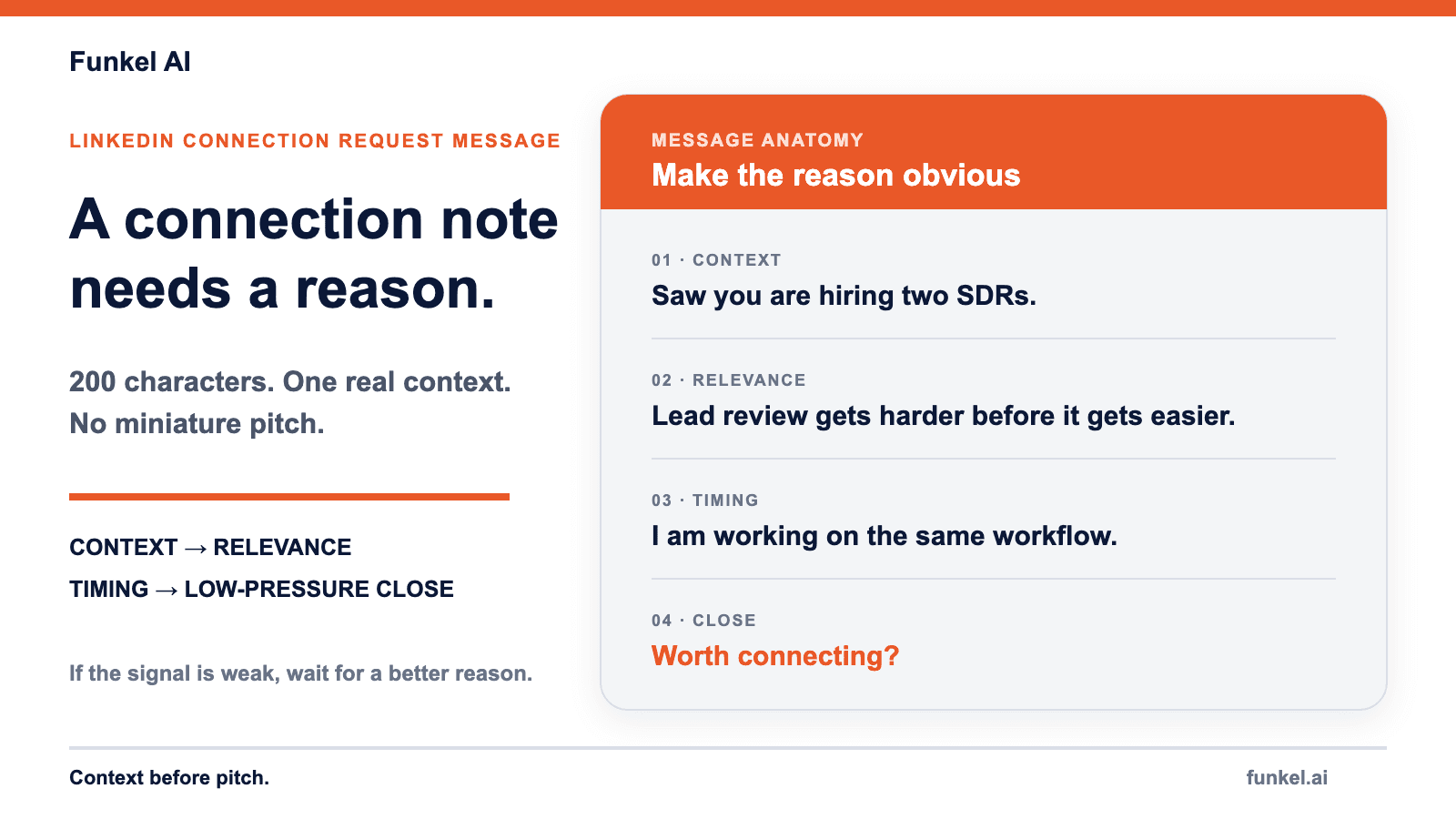
A good LinkedIn connection request message is a short reason for connecting now, not a miniature sales pitch. In 200 characters, name the real context, show why it is relevant, and make accepting feel low pressure. If you cannot point to a genuine reason, a blank request is often better than fake personalization.
Most notes become either generic (“I came across your profile”) or impatient (“Can I show you our platform?”). Both skip the question the recipient is actually asking: why this connection, from this person, today?
LinkedIn connection request message limits in 2026
LinkedIn’s current guidance for personalized invitations says each note can be up to 200 characters. Members without Premium can add a note to three connection requests per month. Premium members can personalize unlimited invitations, although normal connection-request limits still apply.
Some current search results still repeat an older 300-character limit. LinkedIn’s own Help Center, reviewed in September 2026, says 200 characters. Write and test against the first-party limit rather than a copied template article or search summary.
LinkedIn recommends explaining how you found the person, why you want to connect now, and keeping the tone clear and polite. That is a better brief than trying to sound “personalized.” The point is not to prove that you researched every detail of someone’s life. The point is to make the context legible.
A four-part connection request framework
- Context: say where the connection came from: a post, event, role change, hiring plan, public question, or shared community.
- Specific detail: name the one part that made the context relevant. Avoid praise that could apply to anyone.
- Reason now: connect the detail to a problem, decision, or area you genuinely share.
- Low-pressure close: ask to stay connected or pose one small question. Do not ask for a meeting.
You will rarely fit all four parts as full sentences. Treat them as information slots, then remove anything the LinkedIn interface already shows, including the recipient’s name, job title, and company.
Should you add a note, send a blank request, or wait?
A personalized note is useful only when it makes real context easier to understand. Use this decision before trying to improve the copy:
| Action | Decision rule |
|---|---|
| Add a note | Use it when you observed a real post, event, introduction, change, or question. The note should explain why the connection is relevant now. |
| Send a blank request | Use it when the relationship is already obvious from a real shared context. The request itself should be enough. |
| Wait | Use it when you only have a job title, company, generic compliment, or guess. A future reason will be more credible than manufactured relevance. |
The decision table is also a quality gate for automation. A drafting system should be allowed to compress verified context into 200 characters. It should not be allowed to turn a weak profile match into a fictional reason to connect.
Run the 200-character connection note test
Length is only the final check. A 179-character pitch can still be a poor invitation. Review the evidence, relevance, pressure, and length in that order. If the source event is weak, choose a blank request or wait before you edit the words.
source_event:
source_url:
specific_detail:
reason_now:
one_small_ask:
unsupported_claim_removed: yes | no
meeting_request_removed: yes | no
character_count:
decision: send note | blank request | wait| Check | Pass condition | Failure action |
|---|---|---|
| Evidence | The source event is real and reviewable | Wait for a valid reason |
| Relevance | One detail explains why the connection matters now | Remove profile facts and generic praise |
| Pressure | The note asks only to connect or answer one small question | Move the pitch or meeting request out of the invitation |
| Length | The final note contains 200 characters or fewer | Cut greetings and repeated profile details first |
Before and after: remove praise and the meeting ask
Before, 179 characters: “Hi Sarah, I came across your impressive profile and thought we could benefit from connecting. We help companies like yours generate more qualified leads. Open to a 15-minute chat?”
After, 140 characters: “Saw your post on stalled lead handoffs. The missing source context was the key point. I work on that same problem and would like to connect.”
The shorter note keeps a reviewable source, a specific detail, an honest reason, and one small ask. It removes the unsupported compliment, product claim, and meeting request.
Before and after: keep the application context
Before, 190 characters: “Hello, I noticed that you are recruiting a founding AE and wanted to introduce myself. I have relevant experience and would appreciate the chance to discuss the role. Can we schedule a call?”
After, 135 characters: “I applied for the founding AE role. The focus on building the first outbound motion matches my recent work. I would be glad to connect.”
The application is the source event. The revised note keeps one role detail and removes the early call request. The application already carries the full evidence.
Before and after: replace a broad promotion claim
Before, 178 characters: “Congratulations on your promotion. I would love to connect and explore synergies between our companies. We provide an innovative AI platform that can increase sales productivity.”
After, 142 characters: “Congrats on the VP Sales role. Your post named clean handoffs as the first priority. I work on that problem and would value staying connected.”
A promotion alone does not prove a sales problem. The revised note uses the recipient’s public priority as the reason and removes the broad product outcome claim.
18 LinkedIn connection request message examples
These examples are starting points, not copy-and-paste templates. Replace the evidence with the real event you observed. If the detail did not happen, do not use the note.
1. After a useful post
“Your breakdown of attribution debt was sharp, especially the handoff point. I work on the same problem and would like to stay connected.”
Why it works: the note names the exact idea, not a generic compliment, and asks only for the connection.
2. After a role change
“Congrats on the VP Sales role. The first 90 days often expose where pipeline context gets lost. I work on that problem and would value comparing notes.”
Why it works: it connects the role change to a plausible operating problem without pretending to know the recipient’s priorities.
3. When the company is hiring salespeople
“Saw you are hiring two SDRs. That usually makes lead review harder before it gets easier. I am working on the same workflow and would like to connect.”
Why it works: the hiring plan creates timing. The note does not assume that hiring automatically means buying software.
4. After a public tool complaint
“Your comment about moving off Outreach matched what I hear from small teams. Curious what broke first for you. Open to connecting?”
Why it works: it follows the public complaint into a specific diagnostic question instead of converting it into a pitch.
5. After a recommendation request
“Saw your request for better buyer-intent tools. I spend most of my time on signal-led outbound and can share what I have learned. Worth connecting?”
Why it works: it offers relevant experience without claiming that your product is automatically the answer.
6. After a webinar or event
“Your point in the GTM session about timing beating volume stuck with me. I am working on the same trade-off and would like to stay in touch.”
Why it works: the recipient can place you in a real shared moment, and the detail proves you paid attention.
7. From a shared community
“We are both in the Founder-Led Sales group. Your note on reviewing the first 20 leads was practical. I run a similar audit and would like to connect.”
Why it works: shared membership is context, but the specific contribution is the actual reason.
8. After a product launch
“Congrats on the reporting launch. The handoff view is the part most teams skip. I build around that same workflow and would like to follow what you ship next.”
Why it works: it points to a product detail and signals professional curiosity, not an immediate sales agenda.
9. Through a mutual connection
“Maya suggested I follow your work on PLG-to-sales handoffs. I am researching the same transition and would be glad to connect here.”
Why it works: use a mutual connection only when they genuinely introduced you or encouraged the connection. Do not name-drop a shared contact you have never spoken with.
10. Reconnecting with an old contact
“It has been a while since the Berlin SaaS meetup. I saw your move into RevOps and would enjoy staying connected as you build the new function.”
Why it works: the note restores context instead of acting as if the relationship is current.
11. Founder-to-founder
“Building in outbound too. Your post on rejecting volume-first growth captured a trade-off I keep running into. I would like to compare notes over time.”
Why it works: shared category experience is enough when the observation is specific and the ask is patient.
12. When there is no strong signal
Do not manufacture one. Send a blank request only when the relationship is obvious from context, or wait until there is a legitimate reason to connect. “I noticed we both breathe oxygen” personalization is worse than silence.
13. After a public pricing question
“Saw your question about usage-based pricing. The approval step seemed to be the real concern. I work on that trade-off and would like to connect.”
Why it works: the note names the part of the question that matters. It does not assume that the person wants a sales conversation.
14. To a recruiter after a specific role opens
“Saw you are hiring a founding AE. The role’s focus on building the first outbound motion stood out. I work in this area and would be glad to connect.”
Why it works: the note identifies one job requirement and explains the relevant experience. It does not ask for an interview in the connection request.
15. To a hiring manager after applying
“I applied for the RevOps role and appreciated the focus on clean handoffs. My recent work is close to that problem. I would be glad to connect.”
Why it works: the application provides honest context. The note highlights one relevant theme without repeating the full application.
16. Through a shared school or alumni network
“Fellow TU Berlin alum here. Your post on moving from engineering into GTM was useful. I am making a similar shift and would like to connect.”
Why it works: the alumni link starts the note, but the specific post gives the connection a current reason.
17. After a podcast or conference talk
“Your podcast point about reply context getting lost between tools was practical. I work on the same handoff and would like to stay connected.”
Why it works: the note proves that you heard a specific idea. It does not use the event as a pretext for a pitch.
18. After a real customer or partner introduction
“Maya suggested we connect after our call about lead review. I am working on the same bottleneck and would be glad to compare notes here.”
Why it works: the note names the introduction and its subject. Use it only when the person actually made the introduction.
Three connection request messages to avoid
The fake compliment
“Loved your recent content and was impressed by your journey.” Nothing in this sentence proves that you read anything. Replace praise with the exact idea that mattered.
The premature pitch
“We help companies like yours book more meetings. Open to a quick demo?” The connection request is permission to continue, not permission to skip straight to a calendar.
The disguised data scrape
“As the VP of Sales at Acme in Berlin, you must care about pipeline.” Repeating profile fields is not personalization. Useful context comes from a change, decision, question, or problem.
How to write your own note in five minutes
- Write the trigger in plain language. Start with “Saw your...” or “We met at...” and complete the sentence with only what happened.
- Name the relevant detail. Pick one sentence, decision, change, or problem. Do not summarize the recipient’s whole profile.
- Add your honest reason. Explain the shared problem or why following their work would be useful.
- Remove the meeting ask. Replace it with “would like to connect,” “worth connecting?” or one small question.
- Count to 200. Cut greetings, job titles, company names, and adjectives before removing the evidence.
The workflow matters more than the template. Start with a well-defined buyer, watch for real LinkedIn intent signals, and route each signal to a fitting message. Our LinkedIn sales prospecting guide shows how those pieces fit together before the invitation is sent.
What to send after they accept
Continue the same conversation. If the note referenced a tool complaint, the first message should not suddenly become a generic product paragraph. Ask the diagnostic question, share the relevant observation, or offer the promised resource.
This is where most automation creates a context leak: the system records that the invitation was accepted but forgets why the person entered the workflow. A signal-led process keeps the original reason attached to the follow-up. That is also the principle behind useful cold email personalization.
If you want to see how Funkel AI keeps fit, timing, and message context together, read why we built the workflow around buyer signals.
LinkedIn connection request message FAQ
What is a good LinkedIn connection request message?
A good note names a real shared context, explains why the connection is relevant now, and makes a small ask. It stays within 200 characters and does not pitch a meeting, invent a compliment, or repeat profile data.
How long can a LinkedIn connection request message be?
LinkedIn currently limits personalized connection messages to 200 characters. Members without Premium can add a message to three invitations per month; Premium members can personalize unlimited invitations, subject to normal invitation limits.
What should I write in a LinkedIn connection request to a recruiter?
Name the exact role and one requirement that matches your experience. State that you would like to connect. Keep the application, portfolio, interview request, and follow-up details outside the invitation note.
Should every LinkedIn connection request include a note?
No. Add a note when it clarifies genuine context. If you only have a scraped profile field or generic compliment, send a blank request where appropriate or wait for a stronger reason.
Should I ask a question in the connection note?
One small, relevant question can work when it follows directly from a public signal. Avoid discovery questions that demand time, and never turn the note into a qualification form.
How do I shorten a LinkedIn connection request message?
Keep the source event, one specific detail, your honest reason, and one small ask. Remove greetings, names, titles, company descriptions, generic praise, product claims, and meeting requests. Count the final note against LinkedIn’s current 200-character limit.
Can AI write LinkedIn connection request messages?
Yes, when the model receives the actual signal, product context, audience definition, and a strict 200-character instruction. AI cannot rescue a weak reason for outreach. Use it to compress real context, not manufacture intimacy. See our guide to AI-personalized versus manual messages for the decision framework.
Read next
- Best B2B intent data providers: 8 options compared for 2026Compare eight B2B intent data providers by signal grain, evidence to inspect, and the smallest useful first route. Copy a proof-first demo record.
- Buyer intent signals: 11 examples and a signal contractLearn 11 buyer intent signal examples, build a signal contract, and measure signal quality before automating outreach.
- What is B2B intent data? Types, examples, and a practical workflowLearn what B2B intent data is, compare first-, second-, and third-party sources, and use three examples to choose a safe sales action.