Best B2B intent data providers: 8 options compared for 2026
Compare eight B2B intent data providers by signal grain, evidence to inspect, and the smallest useful first route. Copy a proof-first demo record.
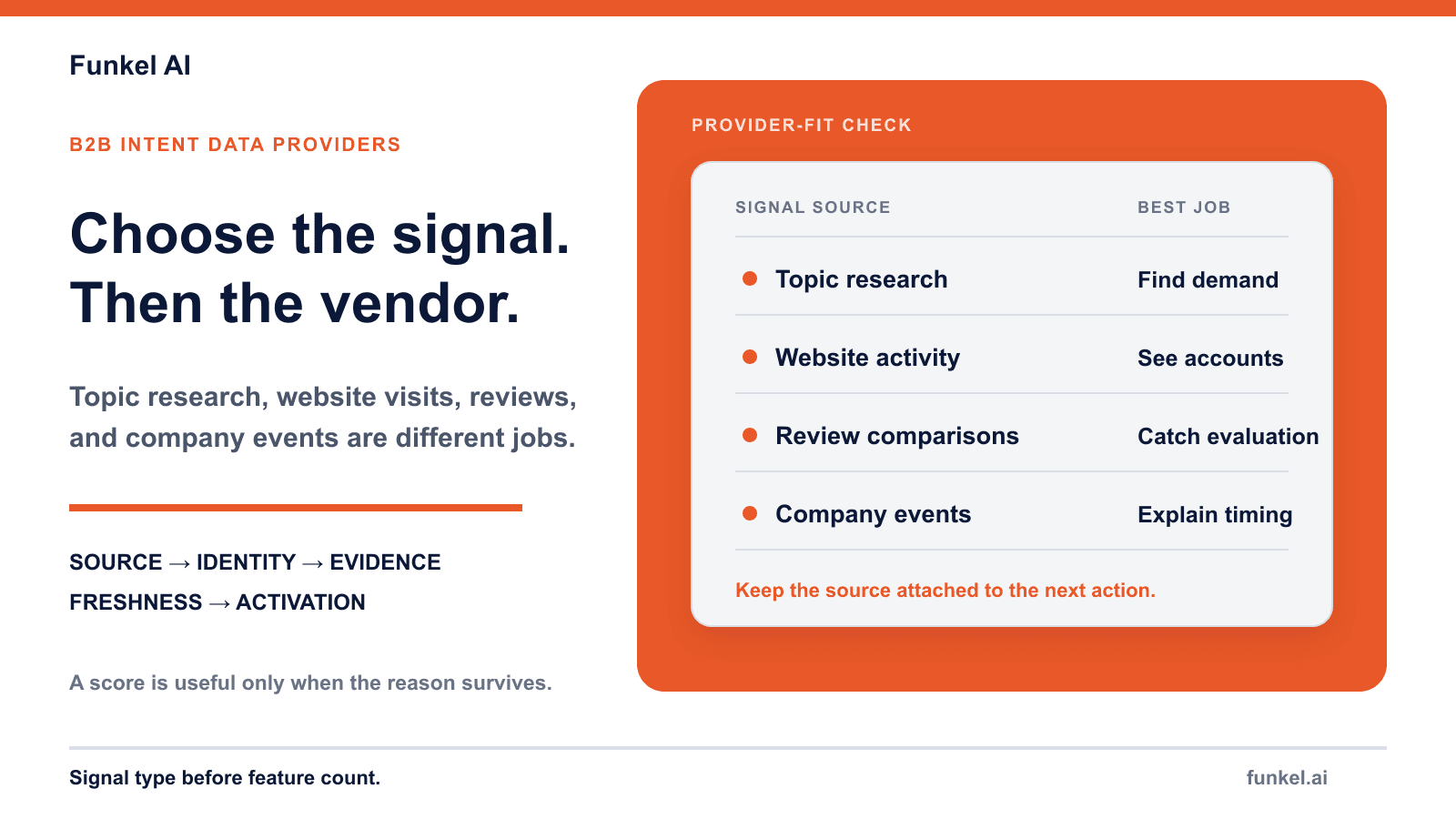
The best B2B intent data provider depends on the signal you need. Bombora fits third-party topic research; 6sense and Demandbase fit enterprise account-based programs; ZoomInfo and Cognism combine signals with contact data; Factors.ai and Leadfeeder focus on website and cross-channel activity; G2 captures review and comparison research.
That distinction matters because “intent data” covers several different products. A company researching a topic across publisher sites, a known customer comparing competitors on G2, and an anonymous account returning to your pricing page are not the same signal. They should not create the same score, owner, or message.
This guide compares eight providers using their first-party product pages. All eight pages were rechecked on September 16, 2026. We did not run a hands-on benchmark or convert vendor customer results into independent proof. “Best for” means the clearest use-case fit, not an objective winner.
Best B2B intent data providers compared
Use the table below to shortlist providers by the evidence you need, not by the largest feature list. Each row keeps the signal at its reported company or person grain, names the proof to request during a demo, and starts with a reversible route before personal outreach.
| Provider | Best for | Evidence to inspect | Smallest useful first route |
|---|---|---|---|
| Bombora | Third-party topic research | Company, topic, baseline, surge window, and timestamp | Prioritize the account for research |
| 6sense | Enterprise predictive ABM | Source signals, account match, stage change, and confidence | Review the account segment and owner |
| Demandbase | Account intelligence and activation | Connected inputs, account mapping, journey change, and date | Create an account-owner task |
| ZoomInfo | Intent plus contact data | Topic or event, identity method, evidence grain, and timestamp | Research the suggested contact |
| Cognism | Company events, technographics, and contacts | Event source, event date, matched account, and person status | Verify the event and route owner |
| Factors.ai | Website and cross-channel journey signals | Page, ad, or review activity with account match and timeline | Send the account to marketing or sales review |
| G2 Buyer Intent | Category and competitor-comparison research | Category, profile, or comparison event with company and date | Review an ABM or customer-success route |
| Leadfeeder | Website visitor identification | Company match, visited pages, session history, and freshness | Research the account before choosing a person |
Choose the signal source before the provider
Start by naming the blind spot in your current workflow. If the team does not know which accounts are researching the category outside your website, third-party topic data may help. If traffic is healthy but forms are quiet, website identification may be the missing job. If buyers compare you with competitors on a review site, comparison intent is a narrower and often more legible signal.
The practical categories are:
- Third-party topic intent: account research across publisher or data-cooperative properties.
- First-party website intent: visits, repeat sessions, key-page views, and campaign engagement on properties you own.
- Review-site intent: category research, profile views, and competitor comparisons.
- Company and people events: hiring, funding, role changes, technographic shifts, and acquisitions.
- Predictive account intelligence: models that blend several sources into an account stage or score.
- Activation: the route from the signal into an ad audience, CRM task, research queue, or reviewable outreach workflow.
If the team cannot name the missing category, a larger platform will produce a larger dashboard without fixing the decision. The existing guide to what B2B intent data is explains the difference between first-, second-, and third-party evidence before you compare vendors.
Separate the provider, the lead source, and the outreach channel
An intent data provider, a lead source, and an outreach channel do three different jobs. A provider detects or organizes behavior. A lead source supplies the evidence or company data that starts a workflow. A channel is a supported place to contact a resolved person. Treating all three as one system hides identity gaps and unsafe routes.
| Layer | Primary job | Typical output | Decision before the next layer |
|---|---|---|---|
| Intent data provider | Detect or organize research and activity | Account, event, score, topic, page, or journey | Is the evidence fresh, inspectable, and relevant? |
| Lead source | Start a workflow with evidence or company data | Post, company row, imported person, or saved list | Can the workflow resolve the right person? |
| Outreach channel | Contact an eligible person from a connected sender | LinkedIn, X, or email step | Do identity, sender access, and approval rules allow it? |
Current Funkel AI source routes show why the distinction matters. Hacker News discovery keeps the public post and leaves unresolved people in review. Clay company rows enter a pending queue and cannot start paid work until an authenticated confirmation. A company CSV search lets the user choose companies and roles, inspect estimates and evidence, and approve eligible people into a lead list. None of those inputs is permission to send.
The complete lead source directory also includes LinkedIn signals, X posts, and trusted saved lists. LinkedIn, X, and email become outreach channels only when the lead has the required identity and the sender connection supports the route.
Match intent data to a role-specific output
A useful intent feed gives each team a bounded output. It does not send the same score into every queue. Define the output, owner, and stop condition before connecting the provider.
| Team | Useful output | Owner decision | Stop condition |
|---|---|---|---|
| Marketing | Account segment with source, topic, and freshness | Nurture, advertise, exclude, or wait | Account leaves the eligible market or evidence expires |
| Sales | Resolved account or person with inspectable evidence | Research, connect, contact, or suppress | Reply, opt-out, identity failure, or stale evidence |
| Customer success | Customer research or competitor-comparison change | Review account health or start a helpful check-in | Existing owner rejects the route or evidence is ambiguous |
| Revenue operations | Source, identity, owner, route, and outcome record | Accept, repair, reroute, or disable the workflow | Duplicate work, missing consent, or broken attribution |
This separation prevents an account-level research surge from becoming a personal sales claim. It also lets customer success inspect a customer change without creating a duplicate sales task.
Copy this B2B intent data provider proof record
Test one real signal during every demo. Record these fields before the vendor shows a score, sequence, or dashboard total.
- Source: where did the behavior occur, and does the provider have permission to collect and use it?
- Identity: is the output a company, a known person, or an inferred contact who may not be the researcher?
- Freshness: when did the behavior happen, when did the team receive it, and when will it expire?
- Evidence: can a rep inspect the topic, page, comparison, event, or journey behind the score?
- Owner: which team and person must review the record?
- Route: can the original reason survive into the CRM, audience, research queue, message, and follow-up?
- Stop: which reply, opt-out, identity failure, exclusion, or age limit blocks the next action?
- Outcome: which decision will prove that the signal changed useful work instead of increasing alert volume?
This is also the difference between useful buyer intent signals and activity that merely looks interesting. A signal should change priority or action. If every account receives the same sequence, the intent feed has become decoration.
Which B2B intent data providers use AI?
Several providers use AI or machine learning, but they use it for different jobs. On the first-party pages reviewed, Bombora describes BERT-based topic analysis, 6sense describes an AI engine that interprets intent and estimates journey stage, and Demandbase describes predictive models across first- and third-party account data. Those are different outputs, not one interchangeable “AI intent” feature.
| Provider | AI or model role described | What a buyer should ask to inspect |
|---|---|---|
| Bombora | Classify the meaning of publisher content and topics | The topic, baseline, surge window, company match, and timestamp |
| 6sense | Interpret combined intent and estimate buyer-journey stage | The source signals, stage change, confidence, and recommended action |
| Demandbase | Blend account data into predictive insights and moves | The connected inputs, account mapping, model output, and owner route |
Other providers in this guide emphasize person-level positioning, event feeds, cross-channel unification, review-site activity, or website identification on the pages reviewed. They may use models elsewhere in the product. The practical test is not whether a landing page says AI; it is whether the team can inspect the original signal, the model’s transformation, and the decision that changed.
Six proof requests for an AI-assisted intent demo
- Show the raw input: open one real source event, timestamp, account match, and topic or page before showing a score.
- Show the transformation: explain what the model classified, predicted, inferred, or combined.
- Show uncertainty: expose confidence, thresholds, or the conditions that keep an account out of a high-intent segment.
- Show one false positive: demonstrate how a user can correct, suppress, or expire a misleading signal.
- Show the handoff: confirm that the source, model output, and reason arrive in the CRM task or review queue together.
- Show governance: identify who can change the model, rules, thresholds, and automatic actions after launch.
This proof sequence keeps AI in proportion. A model can organize noisy evidence and help prioritize accounts. It cannot confirm a purchase, identify an anonymous researcher without an identity method, or make an old signal current.
1. Bombora: best for third-party topic intent
Bombora is the clearest specialist when the missing job is account-level topic research beyond your own site. Its current data page describes a cooperative of B2B publisher sites, Company Surge analysis, business identity resolution, and an integration ecosystem that sends the data into other sales and marketing platforms.
The advantage is focus: Bombora is a data source, not a complete outbound operating system. That is also the buying question. Ask how the topic, location, baseline, surge window, and timestamp reach the person who will act. An account researching a category is useful for prioritization, but it does not prove which employee researched it or authorize a personal claim in outreach.
Good fit: teams that already have CRM, ABM, or sales workflows and need a dedicated third-party research feed.
2. 6sense: best for enterprise predictive ABM
6sense brings native intent and partner sources into a broader revenue platform. Its current product page describes web deanonymization, AI-assisted analysis, account reporting, and integrations with providers such as Bombora, TechTarget, TrustRadius, and G2.
That breadth fits an enterprise account-based program where marketing and sales need one model and activation layer. It may be more platform than a small team needs. Before buying, map the data sources you already own, the systems that must connect, the people who will maintain segments, and the action each account stage should create.
Good fit: established revenue teams running multi-source ABM with operations support.
3. Demandbase: best for account intelligence and activation
Demandbase positions account intelligence as the blend of your CRM, marketing, email, calendar, and website data with its third-party account data. The current page describes account mapping, segments, journey stages, engagement views, enrichment, intent keywords, and account identification.
Demandbase is strongest when the buyer wants the signal and the ABM activation environment together. The hidden dependency is data quality. Predictive stages cannot repair duplicate accounts, unclear ownership, or a CRM that does not record outcomes. Ask which first- party systems must be connected and cleaned before the account model becomes decision-ready.
Good fit: marketing-led ABM teams that want account intelligence, segmentation, and activation in one platform.
4. ZoomInfo: best for intent plus contact data
ZoomInfo combines intent with company and contact data inside SalesOS and MarketingOS. Its current page also positions person-level intent and buying-committee coverage as ways to move from an active account to possible decision-makers.
That can reduce the handoff between an account signal and prospect research. It also makes identity questions more important. Ask how a person-level signal is derived, refreshed, and displayed; whether the rep can inspect the underlying evidence; and what language is safe when the product suggests a contact. Suggested does not mean confirmed researcher.
Good fit: sales teams that want company intent, contact data, and prospecting workflows in the same suite.
5. Cognism: best for company events, technographics, and contacts
Cognism groups several observable changes around its contact-data product. The current Signal Data page includes hiring, funding, job changes, mergers and acquisitions, technographics, and Bombora-powered intent topics.
This mix is useful when timing comes from company events as often as topic research. Keep the routes separate. A new executive, a funding announcement, a technology renewal estimate, and an intent-topic surge require different verification and different messages. Ask which events include dates and source evidence, how duplicates are handled, and what happens when the named contact changed roles.
Good fit: teams that want contact data alongside company-change and technology signals.
6. Factors.ai: best for cross-channel intent capture
Factors.ai focuses on bringing first-party website activity, ad-platform engagement, G2 research, CRM data, and imported third-party sources into one account journey. Its product page also states that it does not provide exact person-level website identification; geography and job-title filters help narrow likely visitors.
That boundary is useful. Account-level website behavior can be strong evidence without pretending to name the individual. Ask the demo to show one real account from first visit through scoring and CRM route. If the rep cannot tell which source changed the score, the aggregation layer may hide the reason your sales team needs.
Good fit: B2B marketing teams that need a shared account journey across website, paid media, review sites, and CRM.
7. G2 Buyer Intent: best for comparison-stage research
G2 Buyer Intent is a narrower second-party signal. Its current page describes companies researching your category, visiting your profile, and comparing you with competitors. It supports acquisition, advertising, and customer-retention use cases.
The source makes the meaning easier to explain than a generic score, especially when an existing customer begins comparing competitors. The limitation is coverage: the category needs enough active G2 research, and the signal still resolves to an account. Ask how quickly comparison activity reaches the right owner and which destinations preserve the viewed category or competitor context.
Good fit: established software categories where buyers already use G2 during evaluation.
Use the guide to review-site research as a buyer intent signal to keep category, product, pricing, alternatives, comparison, and competitor-page activity at the provider’s reported company grain before choosing an owner or outreach route.
8. Leadfeeder: best for website visitor identification
Leadfeeder focuses on identifying companies that visit your website, showing page-level behavior, filtering and scoring accounts, sending alerts, and routing activity into CRM and sales tools.
This is a practical first step for a smaller team because the source is owned and inspectable. A pricing-page revisit can be checked directly. The guardrail is identity: a company visit is not automatically a named buyer. Define the threshold for monitor, research, advertise, or contact before a routine blog visit turns into premature outreach.
Good fit: B2B teams with meaningful website traffic that need company-level visibility and simple routing.
Which B2B intent data provider fits a small team?
Small teams usually need a narrow signal and a clean handoff more than a universal predictive model. Choose the first option that matches the blind spot:
- Anonymous website traffic: start with Leadfeeder or a Factors.ai website-identification pilot.
- Competitor and category comparisons: evaluate G2 Buyer Intent if buyers actively research your category there.
- External topic research: evaluate Bombora, then confirm how the feed enters the tools you already use.
- Contact data plus timing: compare ZoomInfo and Cognism based on region, event coverage, identity evidence, and workflow.
- Enterprise ABM: compare 6sense and Demandbase only after naming the data, operations, and activation requirements.
The public r/b2bmarketing discussion surfaced in the live result set makes the same practical point: teams often need more than one source to cover website activity, social behavior, and third-party research. Read the discussion as buyer language, not as a vendor benchmark.
Run a two-week intent-data pilot before a larger rollout
- Choose one source: one topic set, one review-site event, one website segment, or one company-change feed.
- Define the eligible market: import or match only accounts that already pass the team’s fit criteria.
- Review evidence manually: inspect the first 25 to 50 surfaced accounts before creating automation.
- Assign proportional routes: monitor, research, advertise, connect, contact, or suppress.
- Measure false positives: record wrong accounts, stale events, missing evidence, duplicate signals, and bad owners.
- Check context survival: confirm that the source and reason reach the final task, message draft, and follow-up record.
A provider is useful when the signal changes a decision and the team can explain why. Raw alert volume is not the goal. The signal-mix playbook helps map signal categories to owners and routes, while the sales intelligence tools guide covers the adjacent contact-data and account-research layer.
How Funkel AI fits across source, resolution, and outreach
Funkel AI is not a third-party topic-data cooperative or an enterprise ABM replacement. It gives lean teams one guarded path from public signals, company data, or trusted lists to reviewed people and supported outreach workflows. The source proof stays attached while the system resolves identity, checks fit, and chooses an eligible route.
Hacker News can monitor configured topics and keep each source post. Public discovery and identity checks use no Funkel credits. A successful LinkedIn profile resolution uses 4 credits, and unresolved people cannot enter a LinkedIn campaign. Clay and CSV company inputs use a review and estimate step before paid company-to-person work.
This makes the provider decision simpler. Choose the data source that sees the missing moment, then judge the next system by whether it preserves the reason and blocks unsupported routes. The guide to AI-powered outbound sales automation tools maps that handoff across source, qualification, routing, execution, and memory. See why Funkel AI starts with explainable buyer signals.
B2B intent data provider FAQ
What is the best B2B intent data provider?
There is no universal best provider. Bombora is strongest when third-party topic research is the core need; 6sense and Demandbase fit broader enterprise ABM; ZoomInfo and Cognism pair signals with contact data; Factors.ai and Leadfeeder focus more on first-party website and cross-channel activity; G2 captures review and comparison research.
What should you compare when choosing an intent data provider?
Compare the source of the signal, whether it resolves to a company or person, how fresh the evidence is, what a rep can inspect, where the data activates, and whether the original reason survives into outreach and follow-up.
Is B2B intent data person-level or account-level?
Most intent data is account-level because topic research and anonymous website activity are usually resolved to a company. Some providers add person-level positioning or likely-contact suggestions. Buyers should ask how that identity is derived and avoid treating an inferred contact as the confirmed researcher.
Can a small B2B team use intent data?
Yes, but a small team should start with one signal source and one route. Website identification or a narrow event feed is often easier to validate than an enterprise predictive platform. Measure false positives, freshness, evidence quality, and whether the signal changes the next action.
Which B2B intent data providers use AI?
Several providers use AI or machine learning for different jobs. Bombora describes BERT-based topic analysis, 6sense uses 6AI to interpret intent and estimate journey stage, and Demandbase describes predictive models across first- and third-party account data. Compare the model output and evidence, not the AI label alone.
Does intent data mean an account is ready to buy?
No. Intent data shows observed activity or change, not confirmed purchase intent. A useful workflow combines the signal with buyer fit, checks freshness and evidence, and chooses a proportional action such as monitor, research, advertise, connect, or contact.
Is a lead source the same as an outreach channel?
No. A lead source supplies evidence or company data. An outreach channel is a supported place to contact a resolved person, such as LinkedIn, X, or email. The workflow must confirm identity, sender access, and approval rules before a source can feed a channel.
How should marketing, sales, and customer success use intent data?
Marketing should create inspectable account segments. Sales should receive evidence and one next action. Customer success should receive relevant customer changes with clear ownership and suppression rules. Revenue operations should preserve identity, freshness, routing, and outcome fields across every handoff.
Read next
- Buyer intent signals: 11 examples and a signal contractLearn 11 buyer intent signal examples, build a signal contract, and measure signal quality before automating outreach.
- What is B2B intent data? Types, examples, and a practical workflowLearn what B2B intent data is, compare first-, second-, and third-party sources, and use three examples to choose a safe sales action.
- LinkedIn prospecting: a 7-step workflow and 20-profile auditUse a 7-step LinkedIn prospecting workflow, copy a 20-profile audit, and set clear AI automation and human-review boundaries.