Buyer intent signals: 11 examples and a signal contract
Learn 11 buyer intent signal examples, build a signal contract, and measure signal quality before automating outreach.
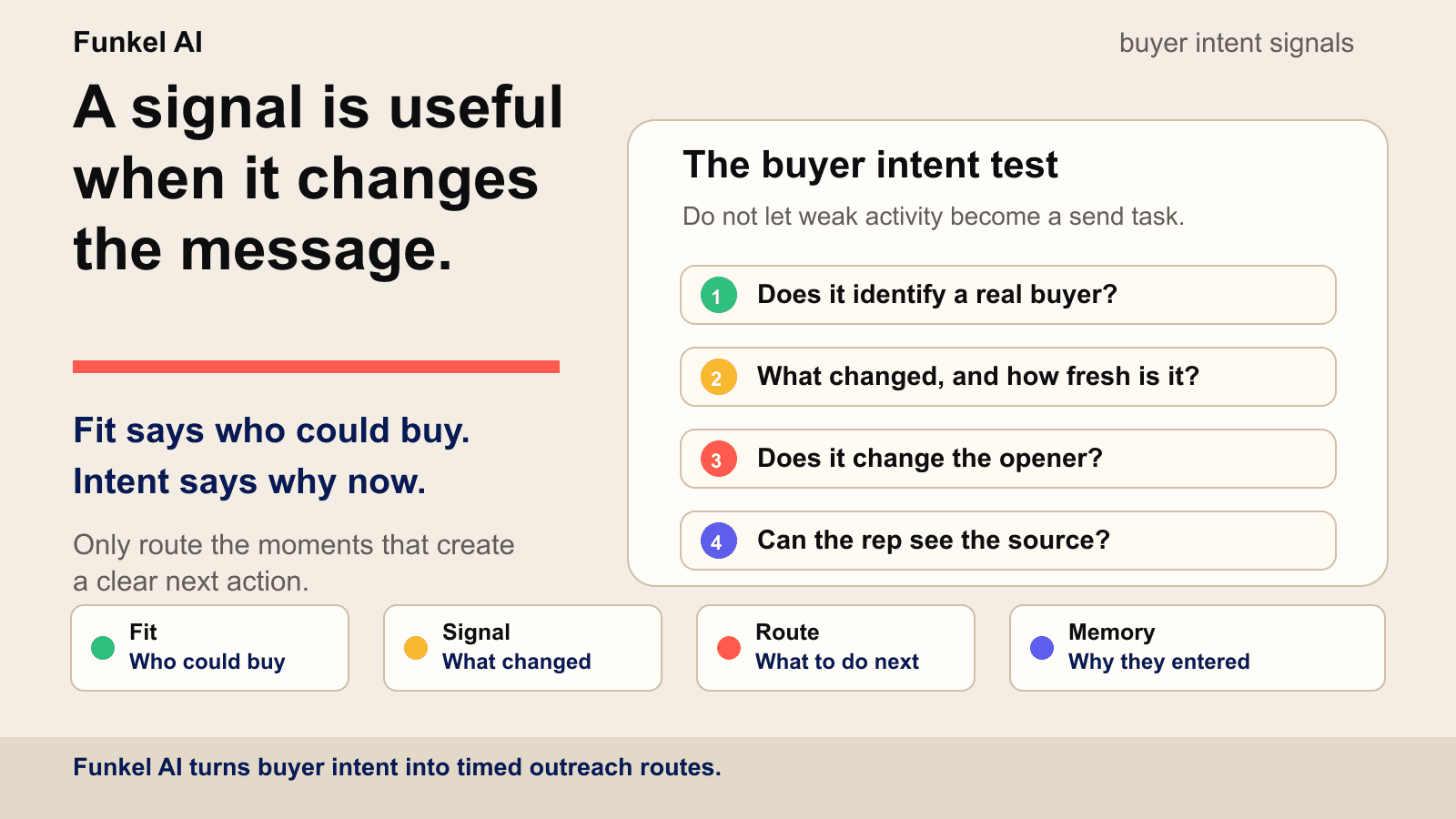
Buyer intent signals are observable clues that a prospect or account may be closer to taking action. They can come from research behavior, public conversations, hiring, role changes, competitor activity, website visits, or warm engagement. The useful ones do more than raise a score. They explain why now, what changed, and what the next message should say.
That last sentence is the test most intent programs fail. A buyer signal is not valuable because it looks predictive in a dashboard. It is valuable when it changes the priority, the owner, the route, or the first sentence of outreach. If the same message would go to every lead in the list, the signal is just decoration.
What buyer intent signals mean in B2B sales
Most B2B intent guides group buyer intent signals into a few broad families: owned web activity, third-party research, review or comparison behavior, organizational changes, and public buying clues. Highspot frames buying signals around behaviors that help reps identify and act on buyer intent, while Demandbase lists repeated site visits, guide downloads, and other engagement as common signal examples. UserGems also breaks the topic into examples, types, and sales use cases.
If the team is choosing a data source, use the guide to B2B intent data providers by signal type to separate topic research, website identification, review-site comparisons, company events, and cross-channel aggregation before comparing feature lists.
The practical outbound definition is narrower: a buyer intent signal should tell you that a fitted buyer has a current reason to care. Fit alone is not enough. Activity alone is not enough. Good outbound starts when fit and timing overlap.
Company-level intent is not person-level evidence
Intent tools often detect activity at the account level. That can tell you which company deserves research without telling you which person created the activity. HubSpot’s buyer-intent documentation, updated July 10, 2026, says its table stores company-level website activity such as visits, unique visitors, last visit, and top page views. It can also surface company research and news signals. Those fields are useful evidence, but they do not identify a buyer by themselves.
Preserve the grain of the evidence before choosing an action. A company signal can justify account research. A named person’s question can justify a person-level response. Converting the first into the second without verification is how an intent program starts to feel like surveillance.
| Evidence card field | Pricing-page example | Decision boundary |
|---|---|---|
| Observed fact | A matched company recorded two pricing-page visits. | Account research is justified. |
| Evidence grain | Company-level activity; visitor identity is unknown. | Do not choose a contact from title alone. |
| Business hypothesis | The account may be comparing approaches or vendors. | Keep this labelled as a hypothesis. |
| Smallest useful action | Check CRM context, known relationships, and current account fit. | Research before person-level outreach. |
| Stop condition | The activity is customer, candidate, bot, internal, or stale traffic. | Remove it from the outbound route. |
Buyer intent signals vs fit data
Fit data tells you whether someone belongs in your market. Buyer intent signals tell you whether there is a reason to pay attention now.
- Fit data: role, seniority, company size, industry, region, business model, current tools, and budget shape.
- Intent signals: new role, hiring spike, competitor complaint, pricing-page visit, product comparison, profile view, category post, recommendation thread, or repeated research behavior.
Fit answers “could this person buy?” Intent answers “why might they care now?” You need both. A perfect-fit buyer with no timing is usually nurture. A high-activity account with poor fit is usually noise.
This is also why buyer intent belongs next to, not instead of, the broader B2B intent data workflow. Data describes the evidence. The signal route turns the evidence into action.
The buyer intent signal trust test
Before a buyer intent signal creates an outbound task, run this five-part test:
- Buyer: does it identify a likely person, or only an account?
- Change: does it explain what moved?
- Freshness: is it recent enough to act on?
- Message: does it change the opener or next step?
- Evidence: can the rep see the source without guessing?
If a signal cannot pass this test, it may still help with scoring, ads, nurture, or account research. It should not automatically create a cold message.
Copy this buyer intent signal contract
A buyer intent signal contract defines what one signal proves, when it expires, and which action it can create. Write one contract for each source before alerts enter a CRM task or campaign queue. This keeps a vague score from becoming unsupported person-level outreach.
| Contract field | What to record | Pricing-page example |
|---|---|---|
| Source and observed fact | The original URL, event, date, and exact activity. | A matched company visited the pricing page twice. |
| Evidence grain | Account, person, browser, session, or unknown. | Account level; the visitor is unknown. |
| Identity and fit rule | What must resolve before a person becomes eligible. | Confirm the account fits. Do not select a contact yet. |
| Freshness window | When the evidence needs review or expires. | Review current activity and the surrounding page path. |
| Allowed route | Observe, verify, research, respond, or outreach. | Research the account and known relationship. |
| Message constraint | Which claim or sentence the evidence can support. | Discuss the problem. Do not mention hidden browsing. |
| Owner and stop conditions | Who reviews it and which facts cancel the route. | Stop for customers, candidates, bots, tests, or stale traffic. |
Copy the field names into your CRM, enrichment table, or review queue. Keep the observed fact separate from the business hypothesis. A rep should be able to open the source, understand the boundary, and choose the next action without reconstructing the logic.
Use an evidence-to-action ladder, not one intent score
A single score hides the most important question: what does the evidence actually justify? Route each signal to the smallest useful action. If you are calibrating a new source, use the free buyer intent signal prioritizer to pressure-test specificity, freshness, fit, and next-step strength before adding it to a campaign.
| Route | Evidence state | Proportionate action | Do not infer |
|---|---|---|---|
| Observe | Weak attention with no owned problem or identified buyer. | Keep the source for trend or nurture analysis. | Purchase intent. |
| Verify | A current event exists, but the source, date, or identity is uncertain. | Open the original source and confirm the fact. | That an alert is accurate. |
| Research | An account fits and shows company-level activity. | Find the business job, current owner, and known relationship. | Which person created the activity. |
| Respond | A named buyer asks a relevant question or describes a current problem. | Answer the question in the channel where it appeared. | Permission for a hard pitch. |
| Outreach | Fit, person, source, freshness, and a recognizable reason align. | Send one reviewed message tied to the evidence. | That the buyer has budget or has chosen a vendor. |
Audit 20 signal records before you automate
Review 20 records from one signal source before it can create automatic work. Use a deliberate mix: eight clear matches, eight ambiguous records, and four records that should stop. The edge cases reveal weak identity, hidden assumptions, and missing exclusions faster than a list of only obvious matches.
| Audit check | Question | Required record |
|---|---|---|
| Source | Can the reviewer open the original evidence? | URL or event reference, date, and observed fact. |
| Identity | Does the evidence name a person or only an account? | Actual evidence grain and resolution state. |
| Fit and freshness | Does the buyer fit, and is the reason still current? | Fit decision, review date, and expiry rule. |
| Route | What is the smallest useful action? | Observe, verify, research, respond, outreach, or stop. |
| Message change | Does the signal change a claim, question, or next step? | The exact supported change, or no message. |
| Stop state | Which evidence makes the record ineligible? | Reason, owner, and suppression or review action. |
Do not automate a source while reviewers must guess the evidence grain, person, freshness, or stop state. Fix the contract, repeat the audit, and keep the signal in research until every action remains explainable.
How to measure buyer intent signal performance
Measure buyer intent signals as a path from captured evidence to a useful outcome. Do not report alert volume as performance. Keep one denominator for each step, then compare sources over the same time window. This shows whether a signal creates useful work or only adds research and review.
| Metric | Calculation | What it reveals | Failure to inspect |
|---|---|---|---|
| Source validity | Verified records divided by captured records | Whether the original evidence exists and remains current | Broken links, stale events, duplicates, or detector errors |
| Actionable signal rate | Records with fit, freshness, owner, and route divided by reviewed records | Whether a source changes a real decision | Account activity with no person, owner, or supported action |
| False-positive rate | Stopped records divided by reviewed records | How often a signal creates noise or an ineligible route | Customers, candidates, bots, poor fit, and expired evidence |
| Median review time | Middle time from capture to a reviewer decision | Whether useful evidence reaches an owner while it is current | Queues that preserve data but lose timing |
| Context survival | Routed records that retain source and reason divided by routed records | Whether evidence survives the CRM, task, and message handoff | Generic outreach that cannot explain why the lead entered |
| Outcome by source | Named outcomes divided by attempted actions for one source | Which source and route combination produces useful results | Blended totals that hide weak sources or unsafe routes |
Define the outcome before the test. It can be a useful public response, a confirmed research task, a connection acceptance, a qualified reply, a booked meeting, or a correct stop. Do not combine these outcomes into one success number. Each route asks the buyer to do something different.
Run a weekly buyer intent signal scorecard
- Choose one source and one week. Keep website visits, public posts, company events, and review-site activity separate.
- Count every captured record. Do not remove failures before you calculate source validity.
- Review evidence and identity. Record each verified, unresolved, duplicate, stale, and ineligible result.
- Record the smallest allowed route. Use observe, verify, research, respond, outreach, or stop.
- Check context at the final handoff. Open the task or message and confirm that the source, reason, and limit remain visible.
- Compare outcomes by source. Keep attempts, positive outcomes, negative outcomes, opt-outs, and stops as separate counts.
A hypothetical week can contain 20 captured records, 16 verified records, nine actionable records, four supported outreach routes, and two qualified replies. Report every stage. Reporting only two replies hides the four invalid records and the seven records that required a different action.
Examples of buyer intent signals worth watching
1. New role or new owner
A new VP Sales, RevOps lead, founder hire, or growth owner often arrives with a mandate to audit process, tools, reporting, or pipeline. The message route is not “congrats on the new role.” The route is the operating pressure they inherited.
Better opener direction: “new owner, inherited pipeline pressure, likely review of outbound workflow.”
Use the guide to job changes as a sales trigger event to verify the person, employer, move type, start date, buyer job, relationship, and current operating evidence before a new title becomes an outreach reason.
When the change affects executive authority, use the guide to leadership changes as a sales trigger to confirm the appointment state, effective date, reporting line, mandate, current operating owner, and visible execution before treating company news as buyer intent.
2. Hiring activity
Hiring is a public operating plan. A company hiring SDRs, growth marketers, RevOps, or lifecycle roles is showing where work is about to increase. The strongest outreach connects the hiring plan to a practical bottleneck: lead review, handoff quality, tooling, reporting, or sender safety.
Better opener direction: “team is scaling, coordination debt is about to show up.”
Use the guide to company hiring growth as a sales signal to separate current requisitions from completed hires, backfills, estimated headcount, and visible operating change before treating a listing pattern as buyer intent.
When one role matters more than the total hiring count, use the guide to role-specific hiring as an intent signal to move from title to tasks, workflow, current owner, corroboration, and a proportional next action.
When the change begins with a capital event, use the guide to funding announcements as a sales trigger to verify the round state, stated use of funds, likely owner, and visible execution before treating company news as buyer intent.
3. Product launches and go-to-market changes
A launch can change the audience, offer, positioning, onboarding, support, infrastructure, or route to market. The announcement alone does not reveal which job is active, whether the offer is available, who owns the work, or whether the company is evaluating anything.
Use the guide to product launches as a sales trigger event to separate the public claim, release state, availability, execution, operating consequence, current owner, and proportional route before a launch becomes outreach.
When the company names a new geography, customer segment, industry, or route to market, use the guide to market expansion as a sales trigger to separate aspiration, testing, committed entry, operating execution, and an owned consequence before treating growth language as buyer intent.
When another organization is part of the change, use the guide to partnership announcements as a sales trigger to verify the parties, relationship type, commitment, responsibilities, live execution, and current owner before treating alliance language as buyer intent.
When the clue comes from a conference, trade show, meetup, roundtable, or field event, use the guide to event attendance as a buyer intent signal to verify the attendance state, participant role, attributable interaction, current owner, and smallest justified next action before treating presence as purchase intent.
When the clue comes from a live webinar, virtual session, or on-demand replay, use the guide to webinar engagement as an intent signal to keep registration, attendance, watch activity, polls, questions, resource actions, and requested follow-up as separate evidence before treating engagement as a buying project.
4. Technology adoption and stack changes
A detected technology, named integration, migration role, or public implementation can reveal operating change. It does not automatically show live use, dissatisfaction, expansion budget, a replacement project, or the person who owns the workflow.
Use the guide to technology adoption as a sales trigger to move from a public stack clue through verified presence, implementation, operational use, and an owned consequence before routing outreach.
5. Competitor pain and alternative searches
Public complaints, migration questions, and alternative searches are high-context buyer signals because the buyer has already named a problem. The route should mirror the pain without attacking the competitor. The goal is to help them compare, not to turn their complaint into a pitch.
When the source is a person describing the problem in their own words, use our guide to direct pain posts as a buyer intent signal to verify authorship, problem ownership, freshness, and the right public or private response before outreach.
When the complaint names another vendor, use the guide to competitor dissatisfaction as a buyer intent signal to verify the reviewer, current product relationship, unresolved workflow consequence, decision owner, and evaluation state before treating frustration as a switching project.
When the clue is company-level activity from G2 or another permitted review platform rather than a named person’s words, use the guide to review-site research as a buyer intent signal to preserve the page type, company match, identity grain, freshness, likely owner, and smallest justified route.
Better opener direction: “you named a specific tradeoff; here is the cleaner way to evaluate it.”
6. Category engagement
Likes and comments on relevant posts can show attention, but they are weaker than explicit problem language. Treat them as context unless the engagement is attached to a buying question, recommendation request, or competitor comparison.
Use the guide to LinkedIn content engagement as an intent signal to separate reactions, reposts, generic comments, first-person questions, and multi-person account patterns before deciding whether to learn, research, answer publicly, review, or stop.
For activity around another vendor, use the guide to competitor engagement as a buyer intent signal to separate passive attention from first-person evaluation evidence, relationship-driven activity, and corroborated account patterns.
When somebody explicitly asks peers to suggest products or providers, use the guide to vendor recommendation posts as a buyer intent signal to separate early category discovery from active comparison and to answer with honest affiliation disclosure.
When a configured word or phrase surfaces the source, use the guide to LinkedIn keyword mentions as a buyer intent signal to separate the member’s own words from quotes and previews, classify the buyer job, remove noisy matches, and keep retrieval separate from intent.
When the source is an X post, use the guide to X posts as B2B buyer intent signals to preserve the original author, quote or reply context, buyer job, account fit, freshness, and smallest justified response before a public post becomes a sales task.
Better opener direction: “light context, low-pressure question, no hard pitch.”
7. First-party website activity
Pricing-page visits, demo-page visits, repeated feature-page views, and return visits can be strong signals when attribution is clean and privacy expectations are respected. The sales route should reference the problem or page theme, not make the buyer feel watched.
Use the guide to pricing page visits as a buyer intent signal to distinguish a session, company, and known contact; remove bots, tests, and customer traffic; verify consent; and choose between page help, watch, account review, or no action.
For return activity across several sessions or pages, use the guide to repeat website visits as a buyer intent signal to keep the identity level honest, separate one visitor from an account pattern, remove measurement noise, and choose a route from the page path rather than a universal visit count.
Better opener direction: “you may be comparing approaches to this problem; here is the useful next question.”
8. Direct email replies
A direct reply carries the buyer’s own words, but a returned message is not automatically positive intent. Questions, objections, timing requests, referrals, opt-outs, out-of-office notices, and delivery failures create different evidence and different stop states. Pause the old sequence before deciding what the reply changes.
Use the guide to email replies as buyer intent signals to separate human responses from automated and delivery events, preserve multi-intent replies, and choose between an answer, hold, reroute, suppression, or operational repair.
Better opener direction: the next message should answer the exact job in the reply—or not be sent at all.
9. Multiple stakeholders at one account
Several people from one company can strengthen an account-research hypothesis when each person supplies independent, role-relevant evidence around the same current decision. A cluster of sessions, contacts, or reactions does not automatically prove a buying committee or give a team permission to contact everyone in parallel.
Use the guide to multiple-stakeholder engagement as a buyer intent signal to verify person and source independence, map role-specific questions, test whether the actions concern one decision job, coordinate one account owner, and preserve each person’s restrictions.
Better opener direction: help the known owner answer the group’s real questions; do not expose tracking or invent a committee.
10. Independent signal stacks
Several signals can strengthen a research hypothesis only when they describe distinct root events, preserve their real account or person grain, and converge on the same current business job. Two provider alerts for one announcement, five pages in one session, or registration followed by attendance are not automatically independent evidence.
Use the guide to buyer intent signal stacking to deduplicate root events, test source and decision independence, apply signal-specific freshness, preserve contradictions, and choose a human-review, research, reply, hold, or stop route without hiding the reasons inside a score.
Better opener direction: use the strongest verified evidence the recipient can recognize; never recite a surveillance-style list of everything you tracked.
11. Warm social moments
Profile views, company-page engagement, replies to a founder thread, and repeat engagement with your public posts are useful because the buyer already crossed an attention threshold. Keep the message short. Move from public attention to one relevant question.
Use the guide to LinkedIn profile activity as a sales signal to separate aggregate visibility, private or semi-private views, named attention, follows, connection requests, and inbound questions before deciding whether to improve, observe, research, reply, or stop.
The mechanics matter here. If the next step is a LinkedIn invite, use the rules in our guide to connection notes that get accepted: cite the real signal, skip the fake compliment, and keep the ask small.
How fresh should a buyer intent signal be?
Buyer intent signals decay. The same signal can be useful today, weak next week, and misleading next month.
- Same day to day 3: strongest for public complaints, recommendation requests, profile views, and active tool-comparison threads.
- Week 1 to week 2: strongest for role changes, new responsibilities, hiring pushes, and new GTM ownership.
- Week 3 to week 6: still useful for larger company changes such as product launches, funding, expansion, or new market entry.
- After six weeks: usually nurture unless a new signal appears.
We break down the more urgent subset in our guide to sales trigger events. The short version: a trigger is the signal that creates a reason to act now.
How to route buyer intent signals into outreach
The route is what turns intent from research into a workflow. For each signal, write down six fields before anyone sends:
- Source: where the signal came from.
- Buyer: which person likely owns the problem.
- Freshness window: when the signal should stop creating action.
- Pressure: what business problem the signal suggests.
- Message angle: how the first sentence should change.
- Owner and next step: who reviews it and what happens next.
This is the part most teams make reps improvise. The CRM gets an intent score. The rep gets a task. The original evidence is buried in another tab. By the time the message is written, the buyer signal has become a generic pitch.
Funkel AI is built around keeping those fields together: buyer profile, signal, source, route, draft, approval, and follow-up memory. The product starts from your URL, turns it into a focused ICP, watches configured signal sources, and surfaces leads with a reason attached. The broader product workflow is on why Funkel AI exists.
Common mistakes with buyer intent signals
Treating every signal as equal
A category post like, a public competitor complaint, and a pricing-page visit should not receive the same priority. Rank signals by fit, specificity, freshness, and the message route they create.
Using account-level intent without person-level context
Knowing that an account is researching a topic is useful. It is not the same as knowing which buyer owns the problem. Outbound needs a person, a reason, and a respectful route.
Letting old signals keep sending
Old intent turns into spam when the workflow never expires it. Every signal needs a freshness window and an exit rule. If the buyer replies, opts out, books, or the signal ages out, the campaign should stop.
Letting AI write without signal context
AI does not fix weak inputs. A model with only name, title, and company writes generic outreach faster. A model with fit, signal, source, pressure, and next step can draft a useful first pass. We cover the decision boundary in when to use AI-personalized vs manual messages.
A simple buyer intent workflow
Start with a narrow version before buying more data or adding more signal sources.
- Define one buyer lane and one painful workflow.
- Choose two signal sources that should change the message.
- Write the route for each signal before collecting volume.
- Review the first 20 leads manually.
- Track accepts, replies, meetings, and skips by signal source.
- Pause the signal that creates weak conversations.
- Expand only after one route consistently produces useful replies.
That is how buyer intent becomes an operating system instead of a dashboard. Find the fit. Confirm the signal. Preserve the evidence. Route the next action. Keep the follow-up tied to the reason.
For the automation layer that preserves the route across follow-up, read outbound sales automation. For the LinkedIn-specific signal taxonomy, read the LinkedIn intent signals field guide.
FAQ
What are buyer intent signals?
Buyer intent signals are behavioral, contextual, or event-based clues that a prospect or account may be researching a problem, comparing solutions, or becoming more likely to buy. Useful signals show what changed and what action should happen next.
What are examples of buyer intent signals?
Examples include pricing-page visits, product-comparison activity, role changes, hiring spikes, competitor complaints, recommendation requests, LinkedIn profile views, category engagement, and repeated research around a problem your product solves.
Are buyer intent signals the same as intent data?
Not exactly. Intent data is the broader evidence category. Buyer intent signals are the specific clues inside that data that a team can interpret and route into action.
How should sales teams use buyer intent signals?
Sales teams should use buyer intent signals to prioritize fitted prospects, choose the right owner, write outreach from the reason, and stop follow-up when the signal expires. The signal should change the next action, not only raise a score.
Does a pricing-page visit prove buyer intent?
No. A pricing-page visit can justify account research, but company-level activity does not identify the visitor or prove budget, authority, or a live project. Verify the evidence grain and known relationship before choosing a person-level action.
What is a buyer intent signal contract?
A buyer intent signal contract defines the source, observed fact, evidence grain, identity state, fit rule, freshness window, allowed route, message constraint, owner, and stop conditions for one signal. It prevents a vague score from creating unsupported outreach.
How do you measure buyer intent signal performance?
Measure each signal source from capture to outcome. Track source validity, actionable signal rate, false-positive rate, review time, context survival, and outcomes by source. Keep the denominators visible so a small number of replies cannot hide weak evidence or routing.
Which buyer intent signal metrics should a team track?
Track captured records, verified records, actionable records, stopped records, median review time, routed records that retain source context, and outcomes by source. Compare one source and one time window at a time instead of blending every signal into one score.
Read next
- How to use LinkedIn for sales prospecting: 7 stepsUse standard LinkedIn people search to test a buyer pool, then follow a 7-step prospecting workflow and audit 20 profiles before outreach.
- How to use LinkedIn Sales Navigator for prospecting: 7 stepsUse a seven-step Sales Navigator workflow, audit 20 leads, fix poor search results, and separate saved searches from lead alerts and outreach routes.
- Best B2B intent data providers: 9 options compared for 2026Compare nine B2B intent data providers by signal grain and evidence. Use a 25-account scorecard to test a shortlist.